Your First Interactive Patch
This page shows how to build actions with sendto keyword. Score syntax is introduced in Your First Score.
Use this score as first-patch.scofo:
BPM 60

NOTE C4 1
    sendto delay_on [1]

NOTE D4 1
    delay 1 tempo sendto delay_time [500]
flowchart LR
    performer[Performer plays C4] --> detected[NOTE detected]
    detected --> openscofo[OpenScofo]
    openscofo --> sendto[sendto delay_on]
    sendto --> host[Pd / Max / Csound / SuperCollider]
Host Receivers
| Host | Receiver for sendto delay_on [1] |
|---|---|
| Pure Data | [r delay_on] |
| Max | [r delay_on] |
| Csound | instr delay_on, scheduled with p-fields |
| SuperCollider | ~oscofo.listen("delay_on", { ... }) |
See Platform Integrations for host-specific sendto behavior.
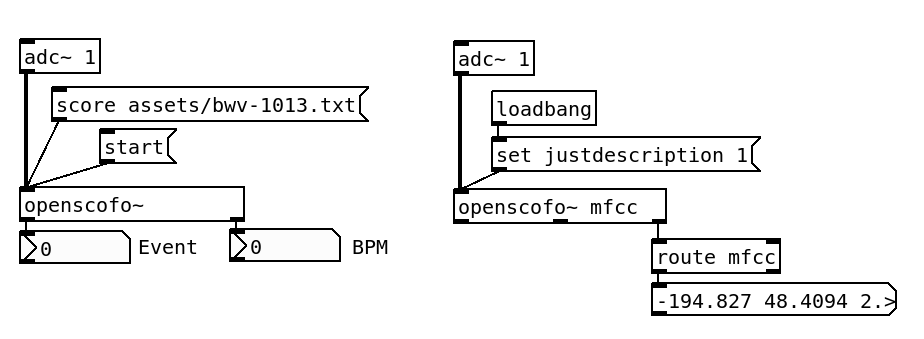
Pure Data
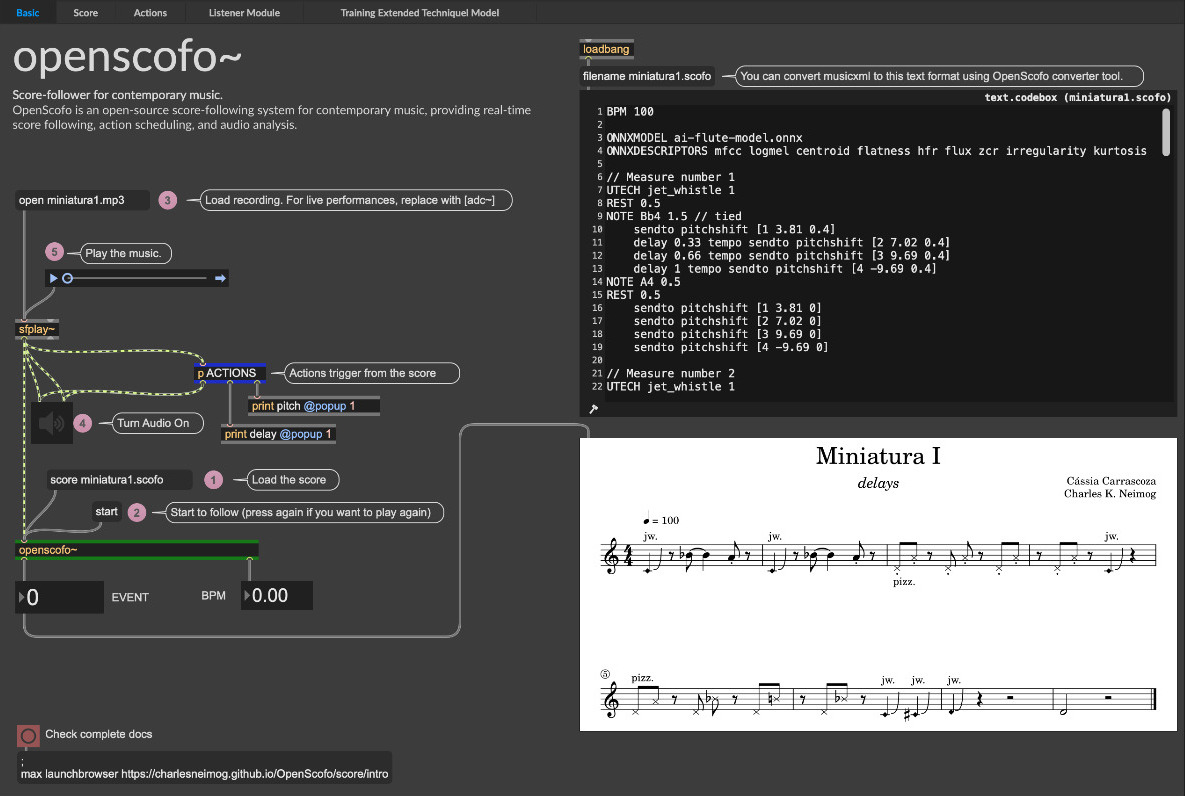
Max
Csound
In Csound, sendto schedules an instrument.
NOTE C4 1
    sendto 2 [0 1 0.7]
<CsoundSynthesizer>

<CsInstruments>
sr = 48000
ksmps = 64
nchnls = 1
0dbfs = 1

instr 1
    a1 diskin2 "./miniatura1.wav", 1, 0, 0
    kEvent, kBPM, kTrig OpenScofoScore a1, "./miniatura1-csound.scofo", 2048, 512
    printf "Event: %03d | BPM: %.2f\n", kTrig, kEvent, kBPM
   out a1
endin

instr 2
    iFreq = p4
    if iFreq <= 0 then
        iFreq = 440
    endif
    iAmp = p5
    if iAmp <= 0 then
        iAmp = 0.20
    endif
    aEnv linseg 0, 0.01, iAmp, p3 - 0.02, iAmp, 0.01, 0
    aTone poscil aEnv, iFreq
    //prints "OpenScofo scheduled instr 2: freq=%f amp=%f\\n", iFreq, iAmp
    out aTone
endin

instr namedPing
    iFreq = p4
    if iFreq <= 0 then
        iFreq = 880
    endif
    iAmp = p5
    if iAmp <= 0 then
        iAmp = 0.12
    endif
    aEnv linseg 0, 0.01, iAmp, p3 - 0.02, iAmp, 0.01, 0
    aTone poscil aEnv, iFreq
    out aTone
endin

</CsInstruments>

<CsScore>
i1 0 30
</CsScore>
</CsoundSynthesizer>
SuperCollider
(
s.options.sampleRate = 48000;
s.waitForBoot {
    ~bus = Bus.audio(s, 1);
    ~namespace = "flute";
    ~buf = Buffer.read(s, "/home/neimog/Documents/Git/OpenScofo/Tests/miniaturas/Audios/miniatura1.mp3");

    SynthDef(\play, { |buf, bus, amp = 0.5|
        var sig = PlayBuf.ar(1, buf, BufRateScale.kr(buf), doneAction: 2);

        Out.ar(bus, sig);              // to OpenScofo
        Out.ar(0, (sig * amp) ! 2);    // to speakers
    }).add;

    s.sync;

    ~oscofo = OpenScofo.new(
        scorePath: "/home/neimog/Documents/Git/OpenScofo/Tests/miniaturas/Extras/miniatura1.scofo",
        inBus: ~bus,
        sampleRate: s.sampleRate,
        namespace: ~namespace,
        eventNotifications: true,
        eventAction: { |eventIndex| "Current Event Index: %".format(eventIndex).postln; }
    );

    // Receives score actions at /<namespace>/buffer-record.
    ~oscofo.listen("buffer-record", { |args, msg|
        var voice = args[0].asInteger;
        var bufferName = args[1].asString;
        var recording = args[2] != 0;

        ["buffer-record", voice, bufferName, recording].postln;
    });

    // Receives score actions at /<namespace>/buffer-play.
    ~oscofo.listen("buffer-play", { |args, msg|
        var voice = args[0].asInteger;
        var bufferName = args[1].asString;
        var gain = args[2];

        ["buffer-play", voice, bufferName, gain].postln;
    });

    ~player = Synth(\play, [\buf, ~buf, \bus, ~bus, \amp, 0.7]);
};
)
NOTE C4 1
    sendto delay_on [1]
For action syntax, see Computer Actions.