Call for Papers
Sonic Thickness
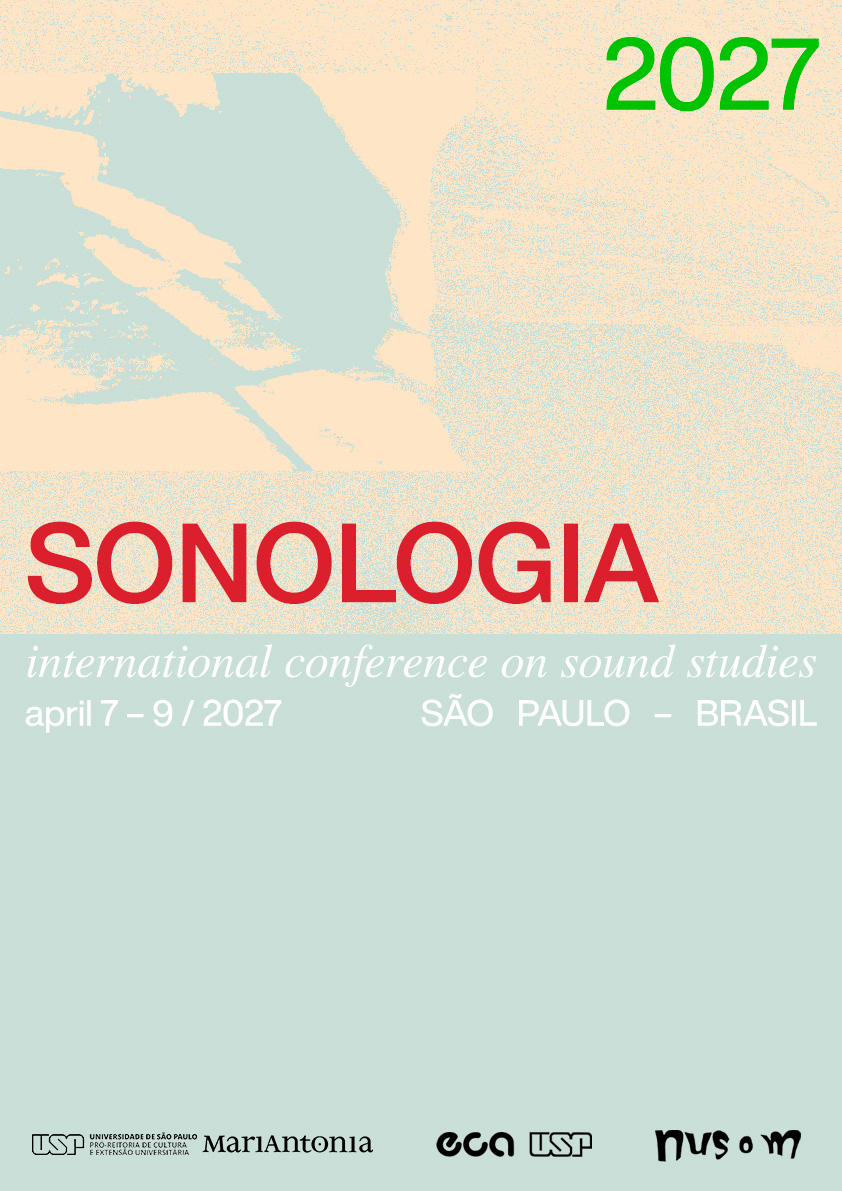
São Paulo, Brazil – April 7–9, 2027
Centro Universitário Maria Antonia – University of São Paulo
Sonologia 2027 – International Conference on Sound Studies will be held in São Paulo, Brazil, from April 7 to 9, 2027. This will be the third edition of the conference, following Sonologia 2016 – Out of Phase and Sonologia 2019 – I/O.
Since its first edition, Sonologia has brought together researchers, artists, and practitioners from different fields, fostering encounters between artistic production, scholarly investigation, technological experimentation, and critical reflection. The conference has been characterized by a strong commitment to transdisciplinary approaches to sound, bringing together perspectives from music, sound art, anthropology, media studies, gender studies, architecture, performance, technology, acoustics, and other fields.
For its third edition, Sonologia 2027 proposes sonic thickness as a starting point for thinking about sound and listening beyond isolated objects, disciplinary boundaries, or fixed categories. The notion of sonic thickness, proposed by composer and researcher Rodolfo Caesar, invites us to consider sound as a phenomenon constituted through multiple layers of perception, experience, mediation, materiality, and context.
Rather than treating listening as an autonomous or exclusively auditory act, we are interested in approaches that explore how sonic experiences emerge through the entanglement of bodies, environments, technologies, histories, territories, memories, and social relations. What becomes audible when different forms of knowledge, perception, and experience intersect? How might sound practices reveal relations that remain inaudible, overlooked, or marginalized within established frameworks?
We are particularly interested in contributions that work across boundaries and in zones of friction: between human and more-than-human; body and environment; local and global; listening and production; materiality and mediation; analogue and digital; memory and presence; artistic practice and research; established traditions and emerging forms.
We invite original contributions that critically and creatively engage with sound, listening, and sonic practices from diverse disciplinary, geographical, cultural, and methodological perspectives.
Possible topics include:
- Politics of sound and listening – power, inequality, institutions, sonic governance, violence, resistance, and the political dimensions of listening and sound-making.
- Technology, mediation, and artificial intelligence – critical approaches to musical and sonic technologies, digital media, algorithmic systems, AI, automation, interfaces, and the social implications of technological change.
- Bodies, voices, and sensory experience – relations between sound, voice, embodiment, movement, affect, disability, perception, and other sensory modalities.
- Territory, place, and sonic geography – field recording, soundwalks, soundscapes, sonic cartographies, acoustic ecology, site-specific practices, installations, urban sound, and the politics of space and place.
- Ecologies of sound and listening – sonic relations between humans, animals, environments, technologies, and other forms of more-than-human agency; environmental listening and ecological approaches to sound.
- Histories, identities, and alterities – race, gender, sexuality, class, coloniality, decolonial and counter-hegemonic perspectives, marginalized histories, and the politics of representation and legitimacy in sound and music.
- Ethnographic and situated approaches – relationships between sound, culture, community, and everyday life, including sonic practices situated outside dominant Western frameworks.
- Artistic research and experimental practices – practice-based research, experimental music, sound art, improvisation, performance, installation, creative methodologies, and alternative forms of producing and communicating knowledge.
- Cross-disciplinary and non-conventional approaches – proposals that challenge established disciplinary categories and explore unexpected intersections between sound studies and other fields.
The list above is not intended to be exhaustive. We welcome contributions that engage with the broader questions raised by the notion of sonic thickness and that propose new ways of thinking, making, sensing, and researching through sound.
Language and format
The official language of the event is English. However, we encourage participants to relate flexibly and inclusively to the language issue during the conference. In line with this perspective, we invite submissions of extended abstracts in English, Portuguese or Spanish. If accepted, participants must submit their complete papers and present them at the conference in English.
We welcome alternative paper formats that respond to the critical and creative needs of theoretical, practice-based, or artistic research (e.g., audio papers, performance papers, etc.). The use of special technical resources, however, must be discussed with and approved by the organizing committee.
Paper presentations should last 20 minutes, followed by up to 5 minutes for questions and discussion.
Submission guidelines
Please submit an extended abstract of up to 1,000 words, in English, Portuguese, or Spanish, along with a short bio of up to 50 words. Submissions must be sent by November 10, 2026, at 11:59 PM Brasília Time (BRT, UTC−3) to sonologia@usp.br.
Authors of selected presentations will be asked to submit a camera-ready paper in English by March 1, 2027. ODT and Microsoft Word templates will be provided by the organizing committee. Papers should not exceed 7,000 words and should follow the provided A4-format template. Accepted papers will be published online in the conference proceedings.
Important dates
- Extended abstract submission deadline: November 10, 2026
- Notification of acceptance: December 18, 2026
- Camera-ready paper deadline: March 1, 2027
Program
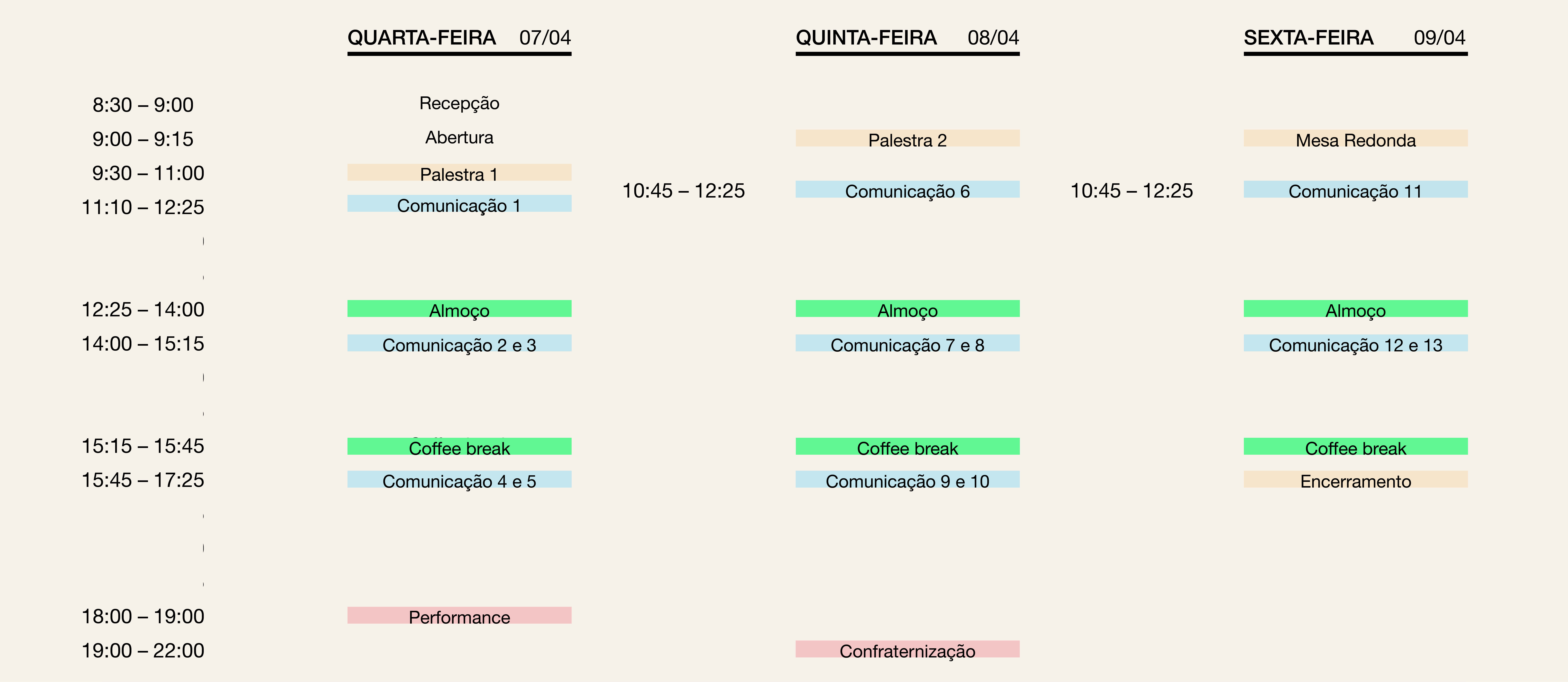
The preliminary program combines keynote talks, research presentations, and roundtable discussions. The final timetable and confirmed speakers will be announced soon.
Presentation format
The draft schedule allocates 20 minutes to each research presentation followed by 10 minutes for discussion. Keynote sessions are planned as 60-minute talks with 30 minutes for discussion. These formats remain provisional.
Travel & Accommodation
Travel &
Accommodation
Sonologia 2027 will be held in São Paulo, Brazil, from to .
Venues are being confirmed. Addresses, directions, and accommodation information will be published on this website once the conference locations are finalized.
For event inquiries, contact sonologia@usp.br.
Organization
Organization
Cássia Carrascoza Bomfim, Charles K. Neimog, Daniel da Silva, Dora Naspolini, Eder Wilker Borges Pena, Fábio Cardozo de Mello Cintra, Fernanda Vaidergorn, Fernando Iazzetta, Gustavo Branco Germano, Herbert Baioco Vasconcelos, Juliana Mayra Teixeira Moreira, Luiz Henrique Otto, Rogério Costa, Thayná Aline Bonacorsi Xavier, and Yuri Prado.
The organizing and scientific committee members will be announced here.
Conference contact: sonologia@usp.br.
Realização


Apoio

Save
the dates.
April 7–9, 2027 · São Paulo, Brazil.